
Speaker's claim that India built Tipaimukh Dam at Abdus Samad Azad's request is false
Speaker Hafiz Uddin Ahmed's claim that India built the Tipaimukh Dam at Abdus Samad Azad's request is false. The project was first proposed in 1926 under British rule and advanced by India's own institutions. No documentary evidence supports Azad's involvement. The dam has not been built as of 2026.
False
Claim Verified
The Tipaimukh Dam was built by India at the request of Bangladesh's Foreign Minister Abdus Samad Azad. We ourselves invited our own destruction.
What is the claim?
On 15 April 2026, during a question-answer session in Bangladesh's National Parliament, Speaker Major (Retd.) Hafiz Uddin Ahmed Bir Bikrom stated: "This Tipaimukh Dam was built by India at the request of Bangladesh's Foreign Minister Abdus Samad Azad. We ourselves invited our own destruction."
The Speaker cited his experience as a former Water Resources Minister as the basis for this claim. He made the statement after BNP lawmaker Abdul Malik (Sylhet-3) raised concerns about the dam's impact on flooding and drought in the Sylhet region.
The claim was reported by Prothom Alo, Bangladesh Pratidin, Jugantor, BSS, and broadcast on multiple television channels (Jamuna TV, Maasranga News). YouTube videos (1, 2, 3) and social media posts have generated widespread discussion and confusion.
Verdict: False — Why?
The Speaker's claim has two core components: (1) India started the Tipaimukh Dam project at Abdus Samad Azad's request, and (2) Bangladesh itself invited this "destruction." Both are factually false.
1. The Tipaimukh Dam was not started at Azad's request — the project was conceived 4 years after his birth
The concept of a dam on the Barak River was first proposed in 1926 under the British Raj — for flood control in Assam's Cachar plains [1]. Abdus Samad Azad was born in 1922 — meaning the project concept was formally raised just 4 years after his birth.
India advanced the project through its own institutions over the following decades:
- 1954: Assam government requested the Central Water and Power Commission (CWC) to develop flood control measures on the Barak River [1]
- 1972: The first India-Bangladesh Joint Rivers Commission (JRC) meeting in New Delhi discussed a storage reservoir on the Barak — this was a joint flood management discussion, not a unilateral "request" [2]
- 1974: The dam site was finalised at Tipaimukh village [2]
- 1977: India's North-Eastern Council directed the CWC to conduct fresh investigations [1]
- 1984: CWC submitted a report proposing the dam; estimated cost Rs 1,078 crore [1]
- 1999: India formally approved the project and assigned it to NEEPCO [2][3]
Abdus Samad Azad served as Foreign Minister from 1996 to 2001. While India's 1999 approval fell within his tenure, this was a sovereign decision by India on its own territory, through its own institutions (CWC, NEEPCO, central government) — not at any Bangladeshi Foreign Minister's "request."
2. No document, treaty, or diplomatic record supports Azad's alleged "request"
Our investigation examined over 20 national and international sources — Observer Research Foundation (ORF) [2], Down to Earth [1], Institute for Peace and Conflict Studies (IPCS) [6], Centre for Research and Advocacy Manipur (CRAM) [10], Business Standard India [4], International Rivers, Hydropolitic Academy, BSS [5], peer-reviewed journal articles published by Springer, and the Boston Globe obituary of Azad [7] — none mention Abdus Samad Azad requesting India to build the Tipaimukh Dam.
Azad's primary diplomatic achievement during his 1996-2001 tenure was the 1996 Ganges Water Sharing Treaty (regarding Farakka), signed by PM Sheikh Hasina and Indian PM H.D. Deve Gowda on 12 December 1996 [8]. That treaty concerned the Ganges/Farakka — not Tipaimukh/Barak River.
BSS's memorial report on Azad's 19th death anniversary [5] and the Boston Globe's international obituary [7] make no connection between Azad and the Tipaimukh Dam. Azad passed away on 27 April 2005 — he cannot respond to this accusation.
3. The Speaker is the sole source — no corroborating evidence exists
Speaker Hafiz Uddin Ahmed stated: "I have some experience as I was Water Resources Minister." He served as Water Resources Minister during PM Khaleda Zia's BNP government from 2001 to approximately 2006 [9]. However, no diplomat, bureaucrat, document, or third-party statement has been found to support his claim. He is a BNP leader, and Azad was from the Awami League — the claim carries a political dimension.
4. The Tipaimukh Dam has not been built to this day
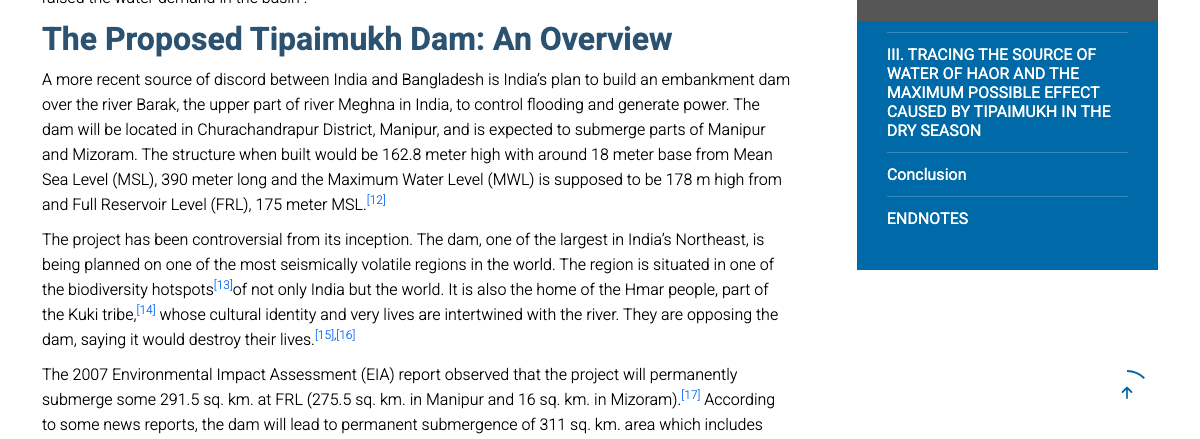
The Speaker said India "started" the dam — but the reality is that as of April 2026, no physical structure has been constructed at the Tipaimukh site. The project remains at the "proposed" stage [1][2][3][6][10].
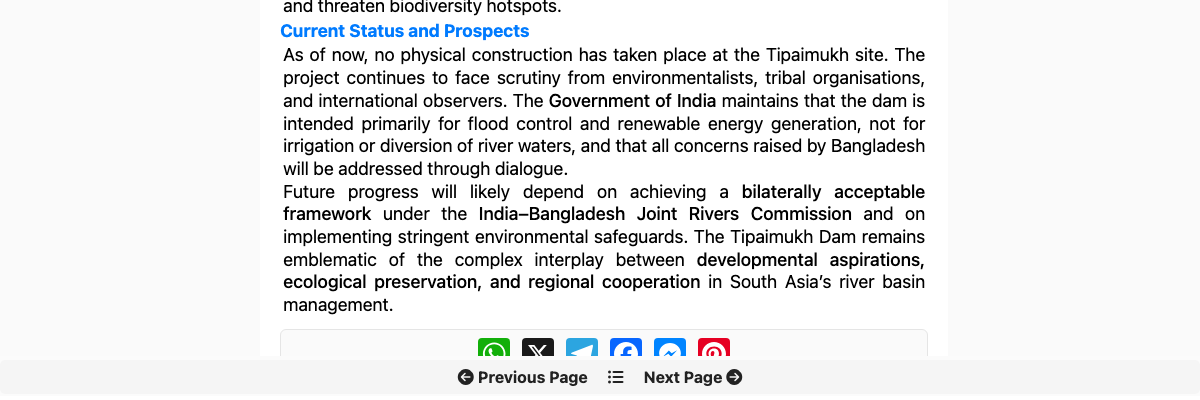
- A foundation stone was laid in 2006, but work was halted in 2007 due to massive protests [10]
- Environmental clearance was granted in 2008, but India's Forest Advisory Committee rejected forest clearance twice — in 2013 and 2014 [3]
- ORF research confirms: the project remains under discussion and no construction has taken place [2]
- GKToday confirms: the project received environmental clearance in 2008 but has not advanced to construction as of 2025 [3]
Some social media users claim the dam was "built in 2009" — this is also incorrect. In 2009, the project was merely transferred from NEEPCO to NHPC [4] — an administrative change, not construction.
Data Analysis
Tipaimukh Dam Project Timeline
| Year | Event | Initiated by |
|---|---|---|
| 1926 | First proposal for dam on Barak River | British government |
| 1954 | Flood control request to central commission | Assam government |
| 1972 | JRC first meeting — Barak reservoir discussed | India-Bangladesh joint |
| 1974 | Dam site finalised — Tipaimukh village | India-Bangladesh joint |
| 1984 | CWC report proposing dam construction | India's CWC |
| 1999 | Project formally approved, NEEPCO assigned | Indian government |
| 2003 | MoU between Manipur government and NEEPCO | Indian government |
| 2006 | Foundation stone laid — Power Minister Sushil Kumar Shinde | Indian government |
| 2007 | Work halted due to protests | — |
| 2009 | NHPC takes over (administrative transfer, not construction) | Indian government |
| 2013-14 | Forest Advisory Committee rejected clearance twice | Indian government |
| 2026 | No physical structure built — still at proposed stage | — |
Key Persons Timeline
| Person | Position | Period |
|---|---|---|
| Abdus Samad Azad | Foreign Minister (1st term) | December 1971 — 1973 |
| Abdus Samad Azad | Foreign Minister (2nd term) | 1996 — 2001 |
| Abdus Samad Azad | Death | 27 April 2005 |
| Hafiz Uddin Ahmed | Water Resources Minister | 2001 — 2006 (approx.) |
| Hafiz Uddin Ahmed | Speaker, 13th Parliament | March 2026 — present |
Conclusion
Speaker Hafiz Uddin Ahmed's claim — that India built the Tipaimukh Dam at Abdus Samad Azad's request — is factually false. The project has been planned since the British era (1926) as India's own initiative, advanced through India's own institutions. No document, treaty, or independent source provides evidence of Azad's "request." Furthermore, as of April 2026, no physical construction of the Tipaimukh Dam has taken place — the project remains at the proposed stage.
Sources (10)
Down to Earth
downtoearth.org.in
Tipaimukh Dam history — 1954 Assam government request, 1965 rejection, 1977 fresh investigation, 1984 CWC report
Observer Research Foundation (ORF)
orfonline.org
ORF research paper — 1926 British-era origin, 1972 JRC discussion, 1999 India approval, project status
GKToday
gktoday.in
Current status: "no physical construction has taken place at the Tipaimukh site"
Business Standard India
business-standard.com
2009: NHPC replaced NEEPCO — administrative transfer, not construction
BSS (Bangladesh Sangbad Sangstha)
bssnews.net
Abdus Samad Azad's 19th death anniversary — no mention of Tipaimukh Dam in his biography
IPCS (Institute for Peace and Conflict Studies)
ipcs.org
India-Bangladesh Tipaimukh Dam dispute — 2003 NEEPCO assignment, 2009 NHPC transfer
Boston Globe
archive.boston.com
International obituary of Abdus Samad Azad — no mention of Tipaimukh Dam
Business Standard India
business-standard.com
1996 Ganges Water Treaty — Azad's diplomatic achievement was Farakka-related, not Tipaimukh
Bangladesh Parliament
parliament.gov.bd
Speaker Hafiz Uddin Ahmed biography — served as Minister of Water Resources, Commerce, and Liberation War Affairs
Centre for Research and Advocacy Manipur (CRAM)
cramanipur.wordpress.com
Detailed project timeline — 2003 MoU, 2006 foundation stone, 2008 environmental clearance
This fact-check was produced by FactCheckerLab. Read our methodology. Report a correction.