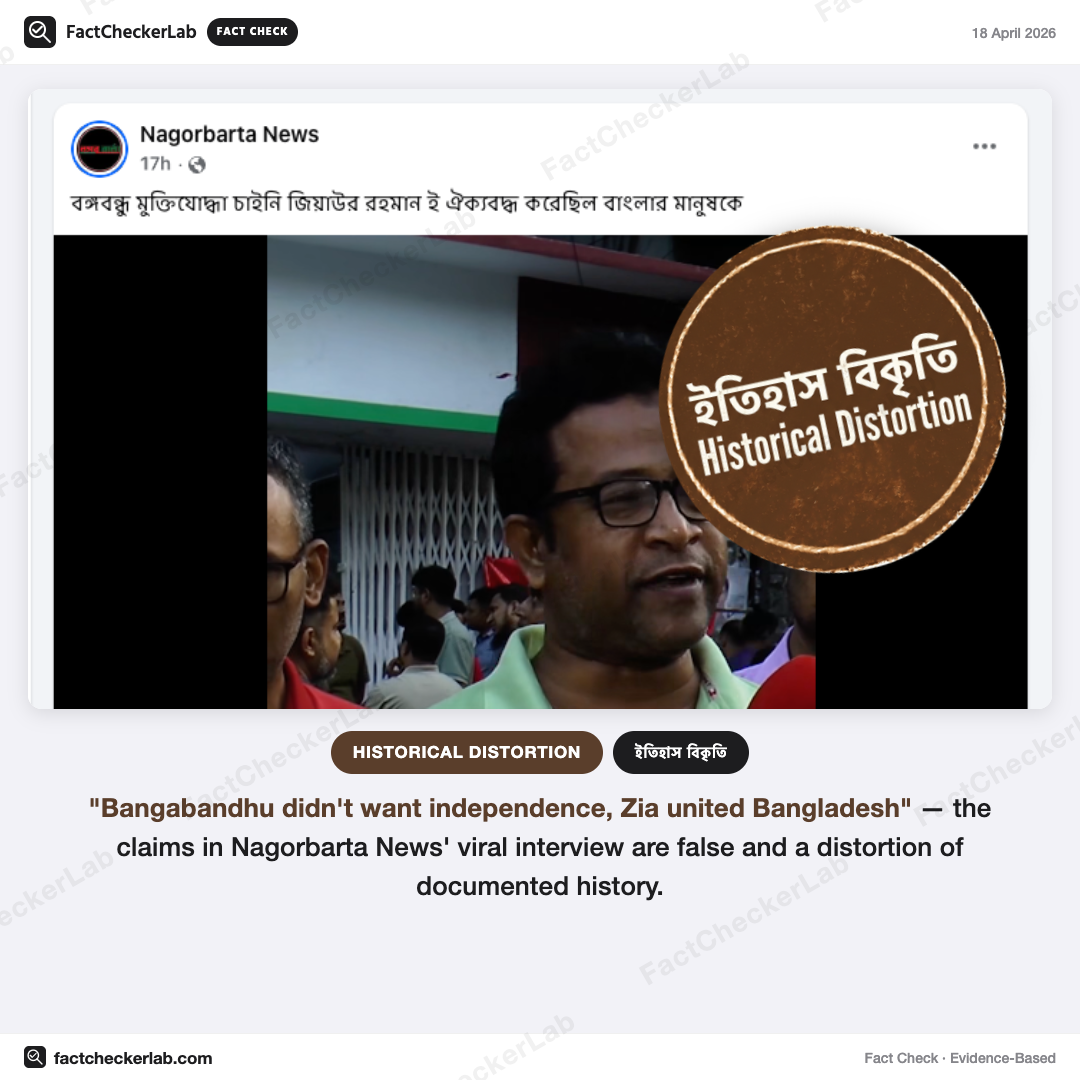
"Bangabandhu didn't want independence, Zia united Bangladesh" — Nagorbarta News viral interview is historical distortion
A viral Nagorbarta News interview features a man claiming Bangabandhu Sheikh Mujibur Rahman never wanted independence and that Ziaur Rahman was the one who united Bangladesh. UNESCO's 2017 recognition, Bangladesh government's 1982 official history, the Mujibnagar Proclamation, and contemporaneous 1971 world media reports all directly contradict these claims. Three eyewitness accounts confirm Ziaur Rahman was specifically instructed by Chittagong's civilian leaders to change his statement to read the declaration "on behalf of Bangabandhu".
Historical Distortion
Claim Verified
A viral interview on Nagorbarta News claims that Bangabandhu Sheikh Mujibur Rahman did not want independence or the Liberation War, that Ziaur Rahman declared independence and united the Bengali people, that the 7 March speech was not a declaration of independence, and that Sheikh Mujib abandoned the nation, surrendered, and fled.
What Was Claimed?
A street interview video published on the Nagorbarta News Facebook page on 17 April 2026 features a man speaking to a journalist holding a Protidin Khobor microphone. Within 17 hours, the video accumulated over 53,000 reactions and 30,000 comments.
The man in a light green polo shirt makes a series of claims:
- "Sheikh Mujib did not want the country to be independent."
- "Sheikh Mujib did not want the Liberation War."
- "I do not see any contribution from Sheikh Mujib after 7 March."
- "Ziaur Rahman united the Bengalis for independence."
- "Ziaur Rahman certainly declared independence."
- "If 7 March had been the declaration of independence, the war would have started from 8 March."
- "Sheikh Mujib abandoned the nation, surrendered, and fled. He returned 25 days after the war ended."
These claims directly contradict documented history, international recognition, the Bangladesh government's 1982 official history of the Liberation War, and firsthand eyewitness testimony from 26-27 March 1971.
Verdict: Historical Distortion — Why?
1. 'Declaring' and 'Reading Out' Are Not the Same
The entire debate hinges on a fundamental distinction:
- To declare (ঘোষণা করা) = the historical authority to decide on and formally announce independence
- To read out (পাঠ করা) = to broadcast an already-given declaration so the public can hear it
Sheikh Mujib declared. Ziaur Rahman read it out. Eyewitness testimony leaves no room for doubt on this.
2. UNESCO Itself Recognized the 7 March Speech as a Declaration of Independence
On 30 October 2017, UNESCO inscribed Bangabandhu's 7 March speech in its Memory of the World Register as documentary heritage of humanity. UNESCO's official page states unambiguously [1]:
"The speech effectively declared the independence of Bangladesh."
The interviewee's argument that "if 7 March had been the declaration, war would have started on 8 March" is fundamentally flawed. Sheikh Mujib deliberately avoided a formal Unilateral Declaration of Independence (UDI), because a formal UDI would have given Pakistan international cover for military suppression of what they could then frame as a 'secessionist movement'. US Ambassador Joseph Farland personally warned Mujib that if he declared UDI, the US would not support it. This was strategic calculation, not failure.
3. Bangladesh Government's Official History: Sheikh Mujib Declared First on 26 March 1971
According to The Daily Star's 2014 investigative report, the Bangladesh government's 1982 official history of the Liberation War establishes a clear timeline [2]:
- Sheikh Mujib wrote down the declaration of independence sometime after midnight on the morning of 26 March 1971
- The declaration was broadcast from Kalurghat in Chittagong on 26 March
- Major Ziaur Rahman broadcast a declaration from Kalurghat on 27 March "on behalf of Sheikh Mujibur Rahman," which was picked up by the foreign press
Prothom Alo's 28 March 2019 compilation of world media from 27 March 1971, surveying 24 major international newspapers including the New York Times, Reuters, Associated Press, Times of India, Bangkok Post, Sydney Morning Herald, and The Guardian — shows that global media learned of Bangladesh's declaration from Sheikh Mujib's 26 March broadcasts, before Zia's 27 March announcement [3].
The Statesman (Calcutta) of 27 March 1971 reported:
"Mr. Rahman, in a message to the world broadcast by an unidentified wireless station monitored in Calcutta this morning... In a subsequent broadcast over a radio station, describing itself as 'Swadhin Bangla Betar Kendra', Mr. Rahman proclaimed Bangla Desh an independent republic."
4. Eyewitness Testimony: Zia Was Instructed to Change His Statement
The strongest evidence of this history comes from three eyewitnesses who were present or played a role during the events at Kalurghat [4]:
(a) Mirza Aboo Mansur (Former MPA Fatikchari, Sector-1 Zonal Commander, eyewitness):
"Sensing that the first statement by Ziaur Rahman would be construed as a coup, Mr AK Khan drafted the second statement which was later read out by Ziaur Rahman, on behalf of Bangabandhu Sheikh Mujibur Rahman on 28th March 1971; as documented in Volume 15 of Govt of Bangladesh Document: 'Liberation War Documents', page no. 129 (reprinted in 2010)."
(b) Dr A R Mallick (then Vice Chancellor of Chittagong University, from his memoir Amar Jibonkotha O Bangladesher Mukti Sangram, page 66):
"On 27 March Ziaur Rahman declared independence in his own name. I remember he said, 'I, Major Zia, do hereby declare...' Right then I voiced my objection. I told Hannan to send news to Kalurghat that the words of the declaration should be changed. Zia could declare independence on behalf of Bangabandhu Mujib. That would bring international support for us. No one in the outside world knew Zia. Thus it was that Major Zia rephrased his declaration."
(c) Belal Mohammad (author of Swadhin Bangla Betar Kendra, pages 40-41):
"I handed him a single sheet of paper. He took out a pen from his pocket. Initially he wrote, 'I, Major Zia, do hereby declare independence of Bangladesh.'
I then told him, 'Would you like to say something like on behalf of Bangabandhu?'
He replied, 'You are right.' Drawing an arrow after his name, he wrote: 'On behalf of our great national leader Bangabandhu Sheikh Mujibur Rahman...'"
Ziaur Rahman did not write "on behalf of Bangabandhu" on his own initiative — Chittagong's civilian leaders, including Dr A R Mallick, A K Khan, and Belal Mohammad, explicitly requested and instructed him to do so.
5. Zia's Own Words: "At the Directive of Bangabandhu"
The Daily Star archive preserves the exact text of Ziaur Rahman's 27 March 1971, 7:45 PM broadcast from Kalurghat Radio [5]:
"I, Major Ziaur Rahman, at the directive of Bangabandhu Sheikh Mujibur Rahman, hereby declare that the independent People's Republic of Bangladesh has been established."
Note Zia's own words: "at the directive of Bangabandhu." The authority for the declaration belonged to Mujib; the duty to read it out belonged to Zia.
6. The Mujibnagar Proclamation of Independence — Sheikh Mujib Is Named as Declarer
The Mujibnagar government's Proclamation of Independence (10 April 1971), which is Bangladesh's legal foundation and was incorporated into the 1972 Constitution, states unambiguously [6]:
"Sheikh Mujibur Rahman duly made a declaration of independence at Dacca on March 26, 1971."
The Proclamation names Sheikh Mujibur Rahman as President of Bangladesh.
7. Mujib Did Not 'Flee' — He Was Imprisoned in Pakistan and Sentenced to Death
The interviewee's claim that "Sheikh Mujib abandoned the nation, surrendered, and fled" is entirely fabricated. According to The Daily Star [7]:
"Bangabandhu was ready and declared the independence of Bangladesh. He courted arrest thinking that it would save Dhaka from total destruction."
Mujib was taken to Lyallpur prison in West Pakistan. On 4 December 1971, a Pakistani military tribunal sentenced him to death (the verdict was kept secret). After Bangladesh's victory, international pressure forced Pakistan to release him on 8 January 1972. He returned to Dhaka on 10 January 1972 via London (where he met British PM Edward Heath) and New Delhi (where he met Indira Gandhi) [7].
Timeline
| Date | Event | Actor |
|---|---|---|
| 7 March 1971 | Speech before 1 million at Ramna Racecourse. UNESCO-recognized 'de facto declaration of independence' | Sheikh Mujib — Declaration |
| Night of 25 March 1971 | Pakistan Army launches 'Operation Searchlight' genocide | Pakistan Army |
| Early morning 26 March 1971 | Formal wireless declaration of independence; arrest follows | Sheikh Mujib — Declaration |
| Evening 26 March 1971 | First broadcast from Swadhin Bangla Betar Kendra; global media reports | Swadhin Bangla Betar Kendra |
| Evening 27 March 1971, 7:45 PM | Broadcast from Kalurghat "at the directive of Bangabandhu" | Major Zia — Reading |
| 10 April 1971 | Mujibnagar Proclamation of Independence | Mujibnagar Government |
| 4 December 1971 | Pakistani military tribunal sentences Mujib to death (secret) | Pakistani Military Court |
| 16 December 1971 | Pakistan surrenders; Bangladesh victorious | Mukti Bahini + Indian Forces |
| 8 January 1972 | Released from Pakistan prison | — |
| 10 January 1972 | Bangabandhu returns home | — |
Conclusion
The claims in the Nagorbarta News viral video — "Sheikh Mujib did not want independence," "Ziaur Rahman united the Bengalis," "Zia declared independence," "Mujib fled" — are directly contradicted by documented history.
UNESCO's recognition, the Bangladesh government's 1982 official history, contemporaneous 1971 world media reports, the Mujibnagar Proclamation, firsthand testimony from Dr A R Mallick, Belal Mohammad, and Mirza Aboo Mansur, and Zia's own recorded words "at the directive of Bangabandhu" — all say the same thing:
- Leadership in 1971 belonged to Sheikh Mujibur Rahman
- The declaration was made by Bangabandhu (7 March and 26 March)
- On 27 March, Zia read that declaration — "at the directive of Bangabandhu"
'Declaring' and 'reading out' are two entirely different words with different meanings. The interviewee has confused — or deliberately inverted — this distinction.
This is not a matter of opinion. It is a rewriting of the documented historical record. For this reason, the verdict on this claim is: Historical Distortion.
Sources (7)
UNESCO Memory of the World — The Historic 7th March Speech
unesco.org
The speech effectively declared the independence of Bangladesh. Inscribed 2017.
Swadhin Bangla Betar Kendro and Bangladesh's Declaration of Independence
thedailystar.net
1982 official govt history timeline + survey of 24 international newspapers from 27 March 1971.
How world media covered the declaration of Bangladesh independence
en.prothomalo.com
90+ global outlets reported Mujib's declaration before his arrest on 26 March 1971.
Zia's declaration — eyewitness accounts
thedailystar.net
Firsthand testimonies from Mirza Aboo Mansur, Dr A R Mallick, Belal Mohammad, Dr Mahfuzur Rahman — confirming Zia was instructed to change his statement to 'on behalf of Bangabandhu'.
March 27, 1971: Zia makes radio announcement on independence
thedailystar.net
'I, Major Ziaur Rahman, at the directive of Bangabandhu Sheikh Mujibur Rahman, hereby declare...'
The Proclamation of Independence was a beacon for Bangladesh
thedailystar.net
Mujibnagar Proclamation (10 April 1971) names Sheikh Mujibur Rahman as declarer of independence on 26 March 1971.
The return of Bangabandhu
thedailystar.net
Mujib arrested 26 March 1971, imprisoned in Pakistan, sentenced to death 4 Dec 1971, released 8 Jan 1972, returned to Dhaka 10 Jan 1972.
This fact-check was produced by FactCheckerLab. Read our methodology. Report a correction.